Your Future is Our Future...
01 Jun 2021
Comments: 0

Is Agricultural Waste A Problem?

When we think of global warming and pollution, we often blame large corporations and vehicle emissions. It’s rare that we connect farming with pollution. Agricultural pollution is on the rise and accounts for 10% of greenhouse gas emissions. But to figure out how to solve the agricultural waste problem, it’s important to understand what agricultural waste is and how agricultural waste does harm the environment.

What Is Agricultural Waste?

Agricultural waste is products disposed of by small and large farms, factories, poultry, and dairy farms. These products are both unintentionally and intentionally disposed of. There are several different types and examples of agricultural waste.

  1. Green waste– this type of waste is considered to come from organic plant matter. Leaves, crop waste, and other materials that decompose. 
  2. Pesticide and feces runoff– pesticides and manure are known to leech into the soil. This not only has the potential to damage soil fertility but also other habitats, animals, and bodies of water. Throughout history, there have been many reported instances of pesticide runoff along with animal feces leaking into surrounding water supplies. 
  3. Gas emissions- Factories and farm machinery produce gas emissions that damage the atmosphere. Methane gas is also produced by the feces of animals, in particular cattle. Livestock emissions are responsible for 14 to 18% of all greenhouse gas emissions. 

How Does Agricultural Waste Impact Us Locally? 

Los Angeles, CA, is an example of how emissions affect local areas. Though most of the pollution created in this region is from high traffic, overpopulation is a classic example of pollution effects. The city has its own weather patterns that are different from surrounding areas. This is theorized to result from pollution. Agricultural trash can produce similar results. 

Not only can this type of pollution damage the quality of the air we breathe but the water we drink. Feces and chemicals are often pumped into holding ponds that have the potential to contaminate groundwater. This can affect local areas and cause numerous health issues. These holding ponds can sometimes overflow resulting in catastrophic damages. 

How Does Agricultural Waste Impact Us Globally?

Globally, we know that waste creates air pollution which damages our atmosphere. These gases from large factory farms, which are one of the direct causes of agricultural waste, release greenhouse gases known as methane, carbon dioxide, nitrous oxide, and fluorinated gases. The greenhouse gases trap heat in our atmosphere causing numerous damages like:

  • Global warming 
  • Low air quality
  • Respiratory complications 
  • Smog
  • Violent weather 
  • Wildfires
  • Melting polar ice caps 
  • Issues with food supply 

What Can We Do To Reduce It? 

There are many efforts we can make as individuals and collectively as a planet to address the agricultural waste problem. The leaders in the agricultural industry are required to apply certain management practices to reduce environmental damage. However, it is not enough. Here are some ways to help:

  • Recycling is one effort all of us can make to help reduce trash. By doing so, we can significantly reduce landfill waste and emissions. 
  • Write your state representatives- there is not as much regulation over agricultural garbage as one would think. Despite the numerous lawsuits and movies made, water contamination regulation needs tremendous attention. Emerging contaminants (ECs) are materials within the water supply that are difficult to measure. Hormones, antibiotics, and pharmaceuticals are examples of this. There is little to no regulation on how much of these are allowed in the water. We need to do better as a country. 
  • Supply and demand- if we as a society create a shift in the needs the supply would change. For example, if we stopped buying a certain produce or meat product in the industry, we default.

Contact Us Today 

At Western Packaging, we are continually developing products that help improve methods for farmers and contractors. We share the goal of reducing agricultural waste by developing products that save time, energy, and resources. Give us a call today!

21 May 2021
Comments: 0

How To Store and Ways To Use Hay

Hay is not just for horses! There are many uses for hay around your farm, yard, or even your business. Using hay is a sustainable resource and good for the environment, but many people find themselves asking what to do with hay.

Key Takeaways:

  • Hay Has Versatile Uses Beyond Livestock: Hay is a sustainable material with many functions around farms and homes, such as animal bedding, weed suppression, garden mulch, pathway lining, and even seasonal decorations.
  • Use the Right Type of Hay for Gardens: When using hay in flower beds or gardens, choose mulch hay to prevent unwanted grass growth. It helps retain moisture, suppress weeds, and promote soil health.
  • Proper Hay Storage is Essential for Longevity: To preserve hay for up to three years, store it in a dry, protected space like a barn, shed, or under a tarp on pallets. Creative storage solutions can help maximize space and maintain hay quality.

The Many Uses of Hay

Surprisingly, there are many uses of hay. Not only is it a great food source for horses and other livestock, but you can use it throughout your farm. It is a great material to use in your chicken coops to help your hens’ nest. The material also helps keep the ground dry by absorbing moisture. It is easy to change out and helps keep your coops more sanitary. Here are some other hay uses that you might want to try:

  • Nesting and bedding areas for animals
  • Weed and unwanted plant smothers 
  • Path or trial lining 
  • Cover up mud patches 
  • Create walkways 
  • Flower beds 
  • Seating if it’s in bale form 
  • Cover newly planted grass seed
  • Use for Fall decorations 
  • Hayrides 

Using it in your gardens and flower beds helps replace the need for mulch. Hay helps to keep the roots of your plants and crops from drying out or being damaged by weather. In the summer months, it also helps keep the roots of your plants cool and the soil moist. It keeps the weeds at bay by smothering out many annoying plants that may try to overrun your garden. If you need to clear an area or patch of land, you might want to think about using hay to smother out and kill the plant life.

How To Use Hay Around Your Yard

Certain types of hay can germinate or spread seeds, so it’s important when using it in your gardens or flower beds that you use mulch hay so that it does not do this. If you were to utilize the kind that does seed, it would eventually grow into more grass. This would cover your garden and destroy your flower beds.

This material is a great way to line walkways, driveways, and gardens. Covering your soil with hay helps lock in moisture. This also attracts decomposing organisms like worms to your garden. It is also great to put in your compost pile. 

Best Ways To Store Hay

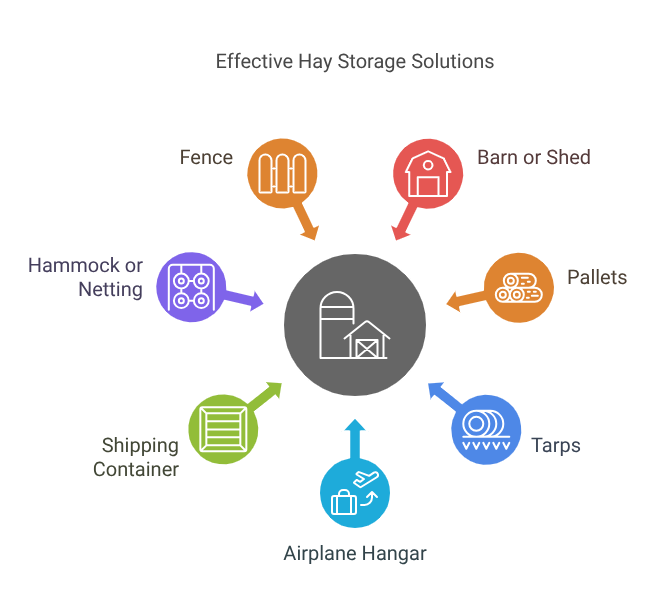
Infographic of creative hay storage ideas, including barn, pallets, tarps, and containers—helpful tips on how to store hay and protect it from moisture.

Hay storage is often a tricky thing as it takes up a large amount of space. You have to store it inside a dry space that won’t be exposed to moisture. It usually lasts for about three years when stored properly.

It is best to store hay bales inside a large barn or shed. Keeping it out of the elements will ensure it lasts and retains as many nutrients as possible. If you do not have a barn or shed large enough you can always store it outside on pallets under a tarp. Keeping it off the ground and fully covered from rain is crucial. Here are some creative ideas on how to store hay:

  • On raised wooden pallets
  • Underneath tarps
  • In an old airplane hanger
  • In an industrial shipping container 
  • Create an industrial-sized hammock or netting between trees
  • On top of a fence under a covering 

Contact Us Today 

Need help storing your hay? Please contact Western Packaging today! They have some amazing experts who can assist with all of your hay packaging needs. Western Packaging has some wonderful products that help you save money and conserve your supply. Anything from bulk bags, Bopp bags, stretch film, hay sleeves, and much more. 

Storing and packaging are not always easy to do. Some people lack knowledge and resources, while others have an issue with space. Getting creative with the way you use and store hay will help you make the most of your product.


02 Apr 2021
Comments: 0

What Are The Different Types of Bulk Bags

There are different classifications and styles of bulk bags that you can choose from. When purchasing bulk bags, you need to have the items in mind that you will be storing in them. That is because it will play a big role in which ones you choose. Western Packaging is a company that can give you excellent information and service when wanting to purchase these bags. 

Classifications Of Bulk Bags

Bulk bags are classified in four alphabetical letters. This is what you will go by when you are purchasing them. Each one is going to serve a different purpose and work better for certain situations. 

Some are made from standard polypropylene and some have antistatic fabric. There are also certain ones that are approved for food grade. The different types are:

  • Type A
  • Type B
  • Type C
  • Type D

Types Of Bulk Bags

The names of the different types of bulk bags are an indication of how they are made. Once you know the classification of the bag that you are needing, you can look at the type you want to use. You can even get bags with liners in them to help protect from moisture damaging what is inside of them.

These liners are sewn in or tabbed at the corners. This is a safety precaution to keep the liner in place. The weight of what you are putting inside of them matters, along with the number of times you want to use the bag. Some of the types of bags you can get are explained below. 

Circular Woven Bags

Circular bags are ones that are known to be fairly easy to load and unload with the forklift. It typically has 4 loop handles at the top and only one seam due to its shape. You can have these bags designed in the size capacity that you are needing.

Four-Panel Bags

Four-panel bags are your typical square tote. There are 4 handles to use when loading and unloading with the forklift. If you plan to stack your bags for loading or storage, these are the best option. These bags are going to hold their shape the best for continual usage. 

Conical Bags

This bag is not designed for storage options. It is more for items that need to be emptied upon arrival to the destination. The spout at the bottom is designed to let you empty the bag completely and not have any residue left over. There are 3 handles at the top to allow it to be lifted during the emptying process.

Form Stable Bags

This bag is very similar to the four-panel bag, but with extra support added to it. There are form stable inserts added at each corner seam. You are able to get better usage and ore storage out of these bags due to their added strength. 

U-Panel Bags

The most commonly purchased bulk bag is the U-panel. It is affordable and efficient in the needs that people have for it. The name describes exactly what it looks like when you load it. It is very easy to lift and load with 4 loops at the top. 

Contact Western Packaging Today

If you are looking for the best choice in bulk bags for your business, give us a call today. We can help you decide on the perfect fit for your needs. Our staff is skilled and knowledgeable to give you the best advice we possibly can. Contact one of our representatives today to get more information about the bulk bags that we carry.


25 Mar 2021
Comments: 0

Can The EBS Handjet Print on Anything?

Do you work for a shipping company or somewhere that labels items? Or maybe you own a small business that does a lot of shipping. Either way, an EBS handjet could be what you have been looking for. Western Packaging is a knowledgeable company that sells these tools and can help you with all your needs. 

What Is An EBS Handjet?

The EBS handjet is a mini portable printer that you can use in many different ways. You can use whatever logo your need or wording to print directly onto the surface you need it to. Some of the many surfaces that it can print onto are:

  • Metal Pipes
  • Boxes
  • Wood
  • Concrete
  • Poly Bags
  • Corrugated Boxes
  • And More

You can only use one color at a time in a printer, but it can be printed on a variety of different surfaces. The cost of an EBS handjet is going to range around $3,500 and higher. Compared to the cost of buying other types of printers, the supplies, and hassle it takes could be worth it for your business. 

Pros Of Using An EBS Handjet

There are a large variety of positive reasons that your business can benefit from owning one of these tools. The main ones being the versatility and simplicity of using them. To name a few of the main reasons that you should look into owning one of these printers for your business are:

  • Reduces The Cost Of Supplies
  • Compact and Light To Carry Around
  • Can Print On Even and Uneven Surfaces
  • Costs-Effective Use
  • It Contains 100,000+ Characters
  • No Wires Involved
  • Built-In Touch Screen
  • Connects To Any PC
  • Can Prints Graphics
  • Battery and Ink Cartridge Included
  • And Many More

When you use an EBS handjet for labeling products, it is going to improve the productivity of your employees. That is due to the ease of using these tools. It can cause faster and more effective work to be done. Any surface of any size can be printed directly on.

Industries That Can Use EBS Handjets

You can use these printers for almost any need that you may have for printing on materials and products. That means that these little portable printers are great for all kinds of different industries. Some examples of different ones are: 

  • The Military
  • Technical JobsFood Industry
  • Construction Jobs
  • Agricultural Industries
  • Food Industries
  • Cable Industries
  • Oil Companies
  • And So Much More

If you work in one of these industries, or another, an EBS handjet can be of use to you. Take it along with you to any location that you need to print on.

What Can I Use The EBS Handjet Printer For?

There are some items that businesses produce that can’t be put into a bag or box. That leaves you with a problem when it comes to labeling your products. The EBS handjet is capable of printing directly onto the item, such as pipes. Some of the many different things that you can print with these hand tools are:

  • Barcodes
  • Symbols
  • Letters
  • Expiration Dates
  • Codes
  • And More

The codes and symbols that you oftentimes see on electrical boxes, pipes, and more can be printed from these handheld printers. 

Call Western Packaging Today

If you are looking for an item like this for your business, call Western Packaging today. We can give you the information you need to make a decision on purchasing an EBS handjet. All of our staff members are qualified and educated to give you top-notch information. We look forward to hearing from you in the very near future.


05 Feb 2021
Comments: 0

Are Hay Sleeves Eco- Friendly?

Do you have a farm or land that you roll hay on? One of the most important things to do for your hay is to protect it. Having hay sleeves to cover your hay is very beneficial in protecting them. Making sure that the hay doesn’t mold or spoil is very important for your profit. 

If you are looking for a great company to get your hay sleeves from, Western Packaging can help you with all of your needs. The employees are very knowledgeable and trained to help you get the information you need to make a decision. No matter your questions or concerns, you are sure to find just what you are looking for with our company. 

What Are Hay Sleeves?

Hay sleeves are a plastic material that is used to cover hay. It keeps it held together and protected from the sun and moisture. When hay bales are being transported it helps keep them safe from all of the movement. 

A lot of times hay is stored in a stall or barn. If you do not have an option to do that with your hay, the sleeves are a great option to give you that protection. This can help you to not lose as much of your hay throughout the year as you would without the protection. 

They Come In A Variety of Sizes

When you are rolling hay, your bale sizes may vary depending on what you have planned for them. The good thing is that you can purchase the hay sleeves in a variety of sizes to fit whatever the need is that you have. 

Bales can range from 4 feet wide by 5 feet tall all the way up to 8 feet wide and 6 feet tall. Some are square and some are round. No matter the size or shape that you have, there is a sleeve available for you to use. 

Why You Should Protect Hay

When your hay bales are subject to the rain, dew, and UV rays it can harm it. Causing deterioration, infestations, mold, mildew, and rotting. The amount of exposure that your hay is subject to is going to depend on the area that you live in. 

If you live somewhere that has a lot of rain, you are risking the potential of mold and mildew. If you live somewhere that experiences a lot of hot humid days, you are risking UV damage and rotting. This is going to cause you to lose money over time. Using hay sleeves is a way that you can protect your hay without having a barn for storage. 

Eco-Friendly Products

It is always great when companies can find a product that is eco friendly. Reducing the amount of waste that occurs is better for the environment. There are so many eco-friendly products these days making it easier for people to make more eco-friendly decisions. 

Hay sleeves that are used to protect hay bales are eco friendly and can be recycled. This creates far much less waste and makes it more affordable to produce the product. Any way that can be found to be more economically conscious is a good choice.

Contact Western Packaging Today

Western Packaging is a company that believes in excellent customer service. We have helped many people and companies with the needed products that they need. If you are looking for high-quality products to provide you with the needs that you have, we can provide that to you. 

Call today to get more information and to speak to one of our employees. We look forward to working with you soon!


21 Jan 2021
Comments: 0

What Are Woven Poly Bags Used For?

Are you wondering what all you can use woven poly bags for? They are a great product that can be used for a multitude of things. If you are looking for a great company to purchase them from, Western Packaging is the one for you. 

They can give you information and help with all your poly bag needs. Providing excellent customer service is our goal, and we will work hard to give you just that. Our team has a lot of experience and knowledge to help you with your poly bag purchases.

What Are Woven Poly Bags?

Poly bags, short for woven polypropylene bags, offer a great option for bagging large items that need to be packaged. They are flexible and able to move easily without tearing, which is beneficial when they are shipped or on store shelves. Many companies will use these bags for animal feed, dirt and soil, and grass seed. 

They are available in a variety of sizes to meet just about any need that you have. You can even customize them to your brand. If you are unsure if these bags will work for you or which ones to choose, continue reading for more in-depth descriptions of the ones that you can use. 

Paper Laminated Polypropylene Bags

These are a great option for versatility and strength. With having the added feature of the paper, they offer a little bit more force. All poly bags that there are come with these easy to open tabs, but yet are durable and don’t rip easily. 

UV Sandbags With Tie Strings

UV bags are a great option for products that are going to be exposed to the sunlight and the weather elements. These types of bags are particularly used for flood control and in construction areas. If you are needing sandbags for outside purposes, UV sandbags with tie strings are the perfect option for you. 

Standard Woven Polypropylene Bags

These are the most common poly bags that are used by many different companies. You see these bags all the time in stores without even realizing it. They are most commonly used for:

  • Dog Food
  • Cat Food
  • Cat Litter
  • Grass Seed
  • Soil
  • Fertilizer
  • Bird Seed
  • Rice
  • Coffee
  • Flour
  • Fruits 
  • Vegetable
  • And Much More…

Laminated Woven Polypropylene Bags

The extra feature of having laminated woven poly bags gives you more protection. You are going to get the added benefits of dust control and water resistance when using laminated bags. These are also very commonly used poly bags and are a great option for many products. 

What Is The Difference In Woven and NonWoven Poly Bags?

The main difference is just as it sounds, one is woven and one is not. Woven poly bags are literally weaved together creating strength in the bag. When they are nonwoven, they are simply just bound together. Both are good options, the reasoning for choosing between the two is a matter of what you are packaging inside of them. 

If you need the added protection and strength, woven is the way to go for your products. You can easily check poly bags to see if they are woven or not. When you are examining the bags, you can see a weave pattern on them if they are woven. 

Call Western Packaging Today

For great service and excellent quality products, you should contact Western Packaging. They are a great company to work with and many products are in stock and ready to ship. Polybags can be just the product that you are looking for. Call today and speak to one of the members of our team for the additional information that you need. We look forward to hearing from you soon.


07 Jan 2021
Comments: 0

How Are Bulk Bags Beneficial To The Business Industry?

Many industries use bulk bags for storage and transport of various supplies. These bags are large and very sturdy. They are designed to hold large amounts of supplies, crops, seeds, or even dirt just to name a few.

What is a Bulk Bag?

A bulk bag is a large, durable sack that is designed to hold large amounts of products. These bags can have loops sewn into the corners for lifting with a forklift. They can also have a liner sewn into them if a business is concerned with moisture control.

Bulk bags are often used by farmers to hold things like fertilizers, dirt, seeds, or grains. Fill spouts and dispensing spouts can be customized to meet your company’s needs. 

How do Bulk Bags Help in Different Industries?

How do businesses use bulk bags? Below are a few different bulk bag applications:

  • Agricultural products: Many agricultural products are destined for use in livestock feed or animal food or human consumption, so chemical-free bags that have been certified to be safe for food products make transporting these products easy and worry-free.
  • Chemical companies: Products used in the chemical industry can be hazardous, but bulk bags come in a variety of options for carrying hazardous materials and reducing the risk of static shock. Western Packaging is proud to have accomplished the requirements to produce hazmat bulk bags that are used for the transportation of hazardous materials or dangerous goods.
  • Food processing: Because many transported foods are dry bulk products, bulk bags are the perfect vessels for transporting food products. Many bulk bags are specifically designed for this application and are certified to be safe for transporting human food-grade products.
  • Construction and mining: Bulk bags are also ideal for transporting construction materials and mining products. Successful construction projects often require huge amounts of raw materials, and successful mining operations generate tons of product. Bulk bags are strong, versatile, and durable enough to get them where they need to go.

Different Types of Bulk Bags

  • The construction of these durable bags is very important. They are made out of woven plastic fibers. This type of material provides the following benefits:
  • Lightweight: polypropylene is one of the lightest commercial plastics, and bulk bags typically weigh only approximately 5-7 pounds. The lightness of the material makes the bags user-friendly and convenient for storage and transport of materials.
  • Durability: Woven plastic is resistant to shrinkage, stretching, humidity, and heat. Even in a hot, demanding environment, woven plastic bulk bags will keep their shape and retain their ability to hold goods safely and effectively. 
  • Flexibility: Woven plastic is soft and pliable, so woven plastic bulk bags are user-friendly because of their flexibility. They can fold into compact shapes for storage, so they leave plenty of space for work on the warehouse or factory floor. 
  • Strength: As the fibers weave over, under, and between one another, they create durable, dense layers that perform very well. They are designed to hold anywhere from 500 to 4000 pounds.

Give us a Call Now!

Western Packaging is eager to meet your needs, no matter what type of bulk bags your business needs. We have specialized bags to help your business run smoothly and efficiently. Our specialists are ready to answer any questions you may have about choosing the proper bags for your business.

Need a special type of dispensing spout? Give us a call to allow us the opportunity to find out your company’s specific needs and design your customizable bags. Giving you exceptional customer service is our goal. Please contact us today.


05 Dec 2020
Comments: 0

What Is Stretch Film?

Stretch film, also known as stretch wrap, is a highly stretchable plastic film that is wrapped around items. It is frequently used to unitize pallet loads but can also be used to bundle smaller items. The different types of stretch film include bundling stretch film, hand stretch film, extended core stretch film, machine stretch film, and static dissipative stretch film.

How it is Produced

Stretch film is a type of flexible film made from polyethylene, a polyolefin plastic material. It is commonly used to create stretch and shrink films. Linear low-density polyethylene (LLDPE) is the most common type, but high-density polyethylene (HDPE) and low-density polyethylene (LDPE) are also available. 

There are two extrusion methods for producing stretch film. It can be blown or cast. Extrusion is the process of manufacturing stretch film and other flexible plastic products. This section will break down the two most commonly used extrusion processes for manufacturing stretch film. Knowing the process, benefits, and cost of each will allow you to better understand which might be best for your company, products, and needs. 

Blown Stretch Film

When the stretch film is blown it means the resin is melted and extruded through an annular die. This forms a thin-walled tube that is then blown up like a balloon. The wrap/balloon is then air-cooled. This is a slower process, but it provides a high-quality film. 

Because blown stretch wrap is more robust and resilient, it also allows for greater load-holding power. This type of wrap offers higher load and stretch capacity, higher memory, and better tear resistance for loads with sharp edges. However, the production cost tends to be higher with this method. The clarity of the wrap is poor due to crystallization and is more noisy when unwound from its roll. 

Cast Stretch Film

Cast stretch wrap is a type of wrap made from thermoplastic material, melted and extruded through a cast extrusion process. When stretch film is cast it means the film is extruded through a slot die, and then it is passed over cooling rollers. This makes the cooling process quicker, but the quality of the film is not as high, and it is produced cheaper. 

This type of wrap provides excellent clarity, reduced stretching force, increased tear resistance, quiet unwinding, and a superior two-sided cling. However, it lacks the load/holding power of blown stretch film and has less memory and tear resistance. 

Benefits Of Using Stretch Film

With its numerous benefits, stretch film is a popular choice for companies worldwide to palletize and contain products for shipping and transportation. Unlike other materials like strapping, stretch film offers many advantages, including improved product containment and securing. This confidence in its effectiveness and value makes it a preferred choice for many businesses. 

With its versatile applications, stretch film plays a crucial role in the world around us. Its use in delivering, transporting, and storing most products we use, eat, display, and store is often overlooked. There are countless products and uses for stretch film, making it a versatile and indispensable tool in various industries. 

What is Stretch Film Used For

Stretch film can be used for many purposes and plays an important role in the world around us. Many people do not realize the part the stretch film plays in delivering and transporting most products that we use, eat, display, and store. There are hundreds of products and uses for stretch film. 

Here is a list of products that are wrapped in stretch film for transportation, storage, and sometimes sales.

  • Palletized Boxes- This is the most common and widely seen use of stretch film. Boxes of different sizes and weights are stacked on a pallet and wrapped with stretch film to keep them together.
  • Buckets- Buckets of items such as paint, liquids, and dry goods are commonly wrapped with a heavier gauge stretch film to keep the contents in and from spilling.
  • Wire Reels- The film can be used to unitize reels together and it can also be used to prevent the wires from unwinding.
  • Canned Beverages- Another common use is to wrap around beverages. They are often stacked high, and they are heavy; using the film keeps them together and from falling over with being stored and delivery purposes. 
  • Furniture- Manufacturers and movers often use stretch film to secure the product, to keep it together, and to keep it from getting damaged while moving.
  • Feed and Seed- Pallet loads of feed and seed or often very heavy. Depending on the weight of the pallet shrink film can be used to keep it stable.

Uses in Palettes

Making sure boxes stay on the pallets and are properly aligned is an important thing in warehouses. In pallet unitizing, stretch film has several functions that can include:

  • Improved stability of products
  • More efficient handling and storage of loads
  • Some dust and moisture protection
  • Some degree of tamper resistance
  • Extend shelf life

How To Choose The Right Stretch Film For You

Choosing the best stretch film for your needs is not just important; it’s crucial. The right stretch film can ensure product stability, safety, and integrity during storage and transit. By understanding the basics of stretch film and your application needs, you can make an informed decision that will protect your palleted products, minimize damage, and reduce financial and product losses. 

Understanding the basics of stretch film and your application needs will better equip you to select the ideal wrap for your business. Factors to consider include load type, product type, application methods, and cost.

Application

The application method you will use for your stretch film significantly impacts your ideal wrap type. Hand Rolls are ideal for low-volume packaging operations or where machinery is not feasible. On the other hand, Machine Rolls are ideal for high-volume environments, as they can apply the film faster and more consistently.

Product Weight and Type

Your ideal choice of stretch film will depend on the type of product you are wrapping and its weight. Light loads, like tissues or paper, can be handled with lighter gauge film. Medium loads, like canned goods, typically require medium gauge film for better performance. And heavy loads, like bricks or chemicals, will require heavy-duty film to accommodate increased weight and potential shifting.

Cost

Balancing cost with quality is crucial for selecting the appropriate material for your products and bottom line. Economic films are thinner, less durable, and suitable for light loads. Premium films, on the other hand, offer better durability, puncture resistance, and stretch for challenging load types.

Call 

Shrink film has many different purposes and can be used in ways most consumers do not think about. For more information contact us.


05 Nov 2020
Comments: 0

What are Shipping Sacks?

When you work in a business that does a lot of packaging and shipping, you are going to be in need of a quality product to use. Western Packaging is a great company that can provide you with shipping sacks and more. Finding the right product can sometimes pose as a difficult task, but we can make it a lot easier for you. 

We strive to ensure that you are receiving the best service that is possible with Western Packaging. It is important for us to carry the products that you are in need of, such as FIBC Livestock Bags, Woven poly bags, and stretch film. You can even have custom printing added to your bags to make them more appealing and display the content and brand. 

Uses of Shipping Sacks

There are a wide variety of uses for these sacks, everything from landscaping needs down to cat litter. The shipping sacks are designed to be durable and strong, giving you confidence that they can carry even the heavy loads without breaking. That is what you need for your company, and can save you money in returns and damaged items. 

Many businesses use shipping sacks to get their products from point A to point B. They are designed to withstand the process of being shipped and the handling of the bags without tearing. You can also add custom printing to your bags. Some of the most common uses for these bags are:

  • Dog food
  • Cat Food
  • Cat Litter
  • Mulch 
  • Cement
  • Grass Seed
  • Horse Feed
  • Goat Feed
  • Pig Feed
  • Bird Seed

What Are Shipping Sacks Made Out Of 

One of the most commonly asked questions is what the shipping sacks are made out of to make them so durable. These sacks are designed to have multi-walls to help them be strong enough for the job. The makeup of the polypropylene sacks allows them to be somewhat elastic and pliable to help with the packaging of the items. 

The importance of having a product that can withstand the shipping process is that you never know what is going to happen. It may rain, storm, or be exposed to high temperatures. There is also a chance that it can be tossed or dropped. 

Shipping Sacks For Every Need

You can purchase shipping sacks of a number of sizes to fit any need that you have for them. Whether you ship small, medium, large, or a variety of sizes you can find it. There are options for UV protection, laminated, paper, and standard for you to choose from. 

  • Laminated

By choosing a bag that has lamination you can give extra protection from dust, moisture, and help to limit the amount of shifting that happens.

  • Paper Laminated

These are durable and strong like the standard versions, but offer extra protection from moisture, handling, and wear.

  • Standard

The good thing about choosing the standard bags is that they are strong and flexible. Making it the perfect option for feed and other products of that nature. The bags can be moved around and handled without tearing open easily. 

Call Today For More Information

If you have been searching for a company to order your shipping sacks from, Western Packaging can help you with your needs. Our staff is knowledgeable and able to answer the questions that you have. If you need advice on the type of sack that will suit your needs best, don’t hesitate to ask. Giving you exceptional customer service is our goal. Please contact us today.


21 Oct 2020
Comments: 0

What is FIBC Bulk Bags

Western Packing is committed to providing our customers with excellent bulk bags and products every time they use them. We strive to provide products that farmers and contractors can use and benefit from. One of the products that we stand behind is the FIBC bulk bags

What is the FIBC Bulk Bag?

A flexible intermediate bulk container, also known as an FIBC bulk bag, is an industrial container made of a flexible fabric that is designed for storing and transporting dry and flowable products. 

FIBC bulk bags are most often made from thick polyethylene material and measure 45-48 inches in diameter and 39-79 inches in height, depending on what is being stored. FIBC bags are designed to contain 4000 pounds of material, depending on the design. The walls are flexible, which makes them perfect for storing and transporting dry bulk solids.

Advantages of FIBC Bulk Bags

The use of FIBC bags has increased over the last several years due to the advantages they have over other containers such as rigid IBCs, paper bags, and fiber, plastic, or metal drums. Some advantages and uses of FIBC bags include:

  • Improved safety- Workers can be exposed to injuries when they move bulk materials in bags and drums. When using bulk bags they require the use of mechanical means to move them such as a forklift, pallet jack, or hoise, this means less manual movement by workers and improved safety for them.
  • Cost Savings-Labor cost can typically be reduced when the bulk bags are used. When you compare the price of positioning and lifting one bulk bag to lifting, opening, dumping, and the disposal of 40 paper bags you can easily see the cost difference.
  • Economical packaging- More material can be shipped for the same price due to the bag capacity increases and the tare weight decreases. FBICs can also be positioned and stacked higher and more efficiently than smaller bags. This maximizes the shipping container and storage space.

Materials that can be stored

A few examples of things that can be stored and transported in FIBC bulk bags include:

  • Chemicals
  • Fertilizers
  • Fiberglass
  • Food products 
  • Grains
  • Construction Material
  • Seeds
  • and more

Types of FIBC Bulk Bags

  • Circular- This is considered the lowest standard of bulk bags. They are made on the loom as a tube and will not maintain its shape when loaded. It tends to bulge out in the middle when weight is applied, and the product will stretch the fabric when under pressure.
  • U-Panel- This is one step up from the circular bag and it is made when two pieces of fabric that resemble a U shape are sewn together and make the bag. It maintains a square shape when loaded.
  • Four-Panel- This bag is made up of four pieces of fabric that make up the sides and one for the bottom. They are all sewn together and are made to resist some stretching and hold the cube shape much better than other types.
  • Baffle- This bag is the best at keeping the cube shape of your product when it is loaded. The reason why is it has additional baffles sewn into each corner to help the bag keep its shape. These bags are the easiest to stack.

Transport and Emptying

When transporting and loading an FIBC bag it is done on pallets or by lifting it from the loops. Depending on the style of the bag this can be done by one person or may take two. Emptying the bags is easy; you can use the special discharge spout or simply cut it open

Contact Us

If you are in the market for some flexible intermediate bulk containers and bulk bags, give us a call. The staff at Western packing understands the issues our customers deal with every day and we are committed to finding you the best solutions.


Call Now Button